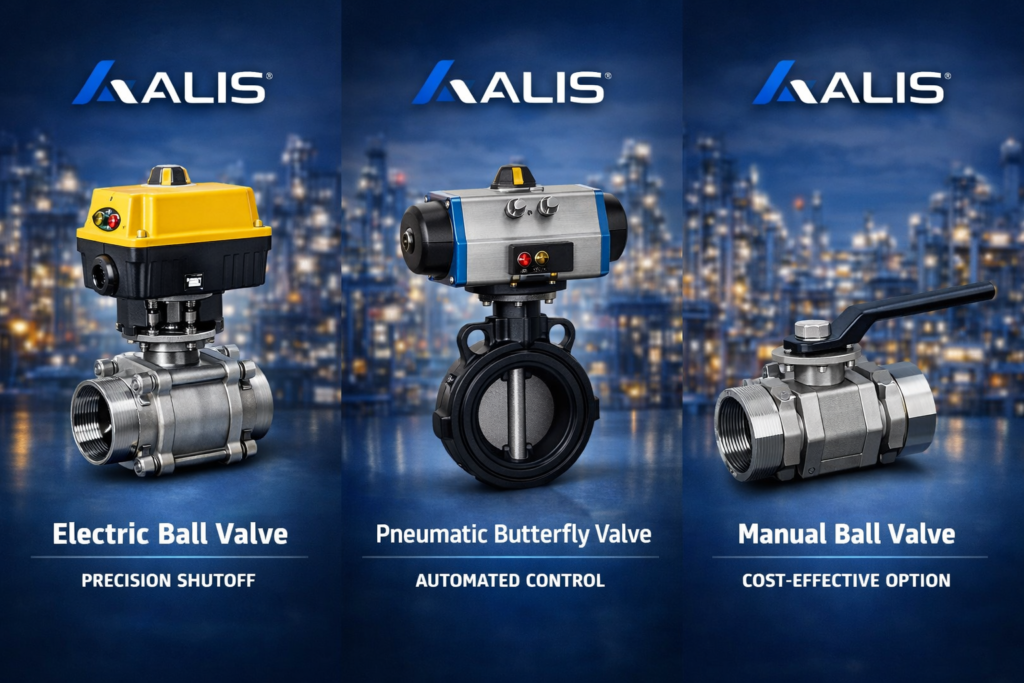

In process industries such as oil and gas, petrochemicals, power plants, water treatment, and pharmaceuticals, valve selection directly impacts operational efficiency and long-term plant economics. Butterfly valves and ball valves are two of the most commonly used quarter-turn valves for flow isolation and control. However, the decision between these valves should not be based only on technical suitability but also on complete financial evaluation. A detailed comparison of CAPEX (Capital Expenditure) and OPEX (Operational Expenditure) helps engineers and procurement teams reduce lifecycle cost while maintaining reliability and process safety. This article analyzes both valve types from a cost perspective, including purchase cost, installation, automation, maintenance, and energy-related expenses.
What is CAPEX in Valve Selection?
CAPEX refers to the upfront investment required for materials and installation. For valves, CAPEX includes:
• Valve purchase cost
• Actuator cost (if automated)
• Installation hardware and labor
• Pipeline modification costs
• Engineering, inspection, and shipping
What is OPEX in Valve Selection?
OPEX involves the long-term running, maintenance, and operational cost of a valve. This includes:
• Repair and service frequency
• Replacement of seals and parts
• Power/air consumption for automation
• Downtime cost due to valve failure
• Operator labor during lifecycle
A valve with low CAPEX but high maintenance cost may become more expensive in the long run. Therefore, industries must analyze both parameters together.
CAPEX Comparison: Butterfly Valve vs Ball Valve
Butterfly valves generally have a major advantage in CAPEX, especially when pipeline diameter increases. The compact disc design requires less raw material, making them more economical. Meanwhile, ball valves become heavier and thicker with size, increasing material and machining cost.
Key CAPEX points:
• Butterfly valves have lower purchase cost for sizes above 200 mm
• Installation is easier due to lightweight design
• Actuators are smaller and less expensive because torque is lower
• Ball valves require larger actuators and support structures
• Large ball valves significantly increase shipping cost
For small to medium diameters (below DN150), the price difference may be minimal, and technical requirements often determine the choice. However, in large pipelines used in water supply, desalination, and cooling circuits, butterfly valves are more cost-advantageous.
Conclusion for CAPEX:
Butterfly valves are the most economical choice when initial investment reduction is a major priority.
OPEX Comparison: Maintenance and Reliability
Butterfly valves have a simpler design with fewer moving parts. This generally translates into lower maintenance cost. Seat and shaft seal replacement are relatively easy and inexpensive. However, butterfly valves may show sealing degradation in slurry or abrasive applications.
Ball valves provide bubble-tight shutoff and superior sealing over a longer period, especially in high-pressure, high-temperature, and corrosive services. Their inline maintenance capability in trunnion designs can reduce downtime.
Key OPEX points:
• Ball valves have lower leakage and better safety performance
• Butterfly valves may require more frequent seat replacement in severe media
• Ball valves withstand pressure shocks and high cycling better
• Butterfly valves may cause cavitation in throttling positions, leading to wear
Conclusion for OPEX:
Ball valves generally offer lower operational and failure-related cost in critical applications.
Energy and Actuation Cost
Power requirement influences long-term OPEX, especially in automated process plants. Because butterfly valves require lower torque, actuator sizing and energy consumption are lower compared to ball valves.
• Pneumatic automation cost is lower for butterfly valves
• Electric actuators for ball valves are heavier and consume more energy
• Faster response of butterfly valves improves process efficiency in water networks
Ball valves, due to full-bore design, have minimal pressure drop, reducing pumping cost in high-flow systems. Therefore, energy savings may favor ball valves in certain continuous-flow environments.
Lifecycle Cost Analysis (LCC)
Engineers often perform lifecycle costing to make financial decisions. It considers:
LCC = CAPEX + OPEX – Residual Value
General LCC trends across industries:
• Water and wastewater → Butterfly valves deliver lower LCC
• Oil and gas → Ball valves deliver lower LCC
• Chemical process media → Depends on corrosion severity and control strategy
• Power plants → High-performance butterfly valves preferred for steam isolation
Industries with automated large pipe networks typically prefer butterfly valves for economic reasons. Safety-critical services with expensive process fluids generally justify ball valve OPEX benefits.
Physical Size, Weight, and Space Constraint Impact
Space availability plays a major role in industrial skid design. Butterfly valves offer a slimmer profile with shorter face-to-face dimensions, reducing structural cost. Ball valves require more space, which may add construction and installation cost.
Performance Cost Correlation
While pricing is important, valve failure can cost millions in production loss. Ball valves minimize leakage, maintaining product integrity and ensuring shutdown reliability. Butterfly valves, while cost-effective, may not always match the same sealing reliability in extreme duty.
Procurement Guidance Summary Table
| Decision Criteria | Best Choice | Reason |
|---|---|---|
| Large pipeline sizes | Butterfly Valve | Lowest CAPEX & automation cost |
| High pressure or temperature | Ball Valve | Superior sealing and durability |
| Slurry / abrasive service | Depends on design | Both need specialized trims |
| Tight shutoff & safety critical | Ball Valve | Zero leakage, API compliance |
| Frequent modulation | Butterfly Valve | Better controllability |
| Budget-focused projects | Butterfly Valve | Reduced lifecycle cost in general utility lines |
| Hazardous media containment | Ball Valve | Higher integrity reliability |
FAQS
Which valve offers the lowest initial cost for process plants?
Butterfly valves provide the lowest CAPEX, especially for large pipeline sizes due to lightweight design and reduced actuator cost.
Which valve has the lowest long-term maintenance cost?
Ball valves usually have lower OPEX in critical pressure and hazardous service due to better sealing performance.
Are butterfly valves suitable for automation in process plants?
Yes, they require lower torque, making automation more economical, especially in water and HVAC networks.
Which valve should be used for zero-leakage performance?
Ball valves are ideal because they deliver bubble-tight shutoff and comply with stringent leakage standards.
Does pipeline size affect cost comparison?
Yes, cost advantage shifts significantly toward butterfly valves as pipeline diameter increases.
Can both valves be used for throttling?
Butterfly valves are better for modulation, while ball valves may require special trims for throttling to avoid seat wear.
Conclusion
Butterfly valves and Ball valves both support essential flow control functions in industrial environments. Their cost performance varies with application type and service severity. Butterfly valves help reduce CAPEX and automation investment while providing excellent value in large water and utility pipelines. Ball valves justify higher investment through reduced OPEX in critical processes with high safety and leak-free requirements. A balanced selection approach must consider pipeline size, pressure rating, medium characteristics, maintenance accessibility, and long-term energy usage. Evaluating both CAPEX and OPEX ensures optimal financial and operational performance across the full valve lifecycle.