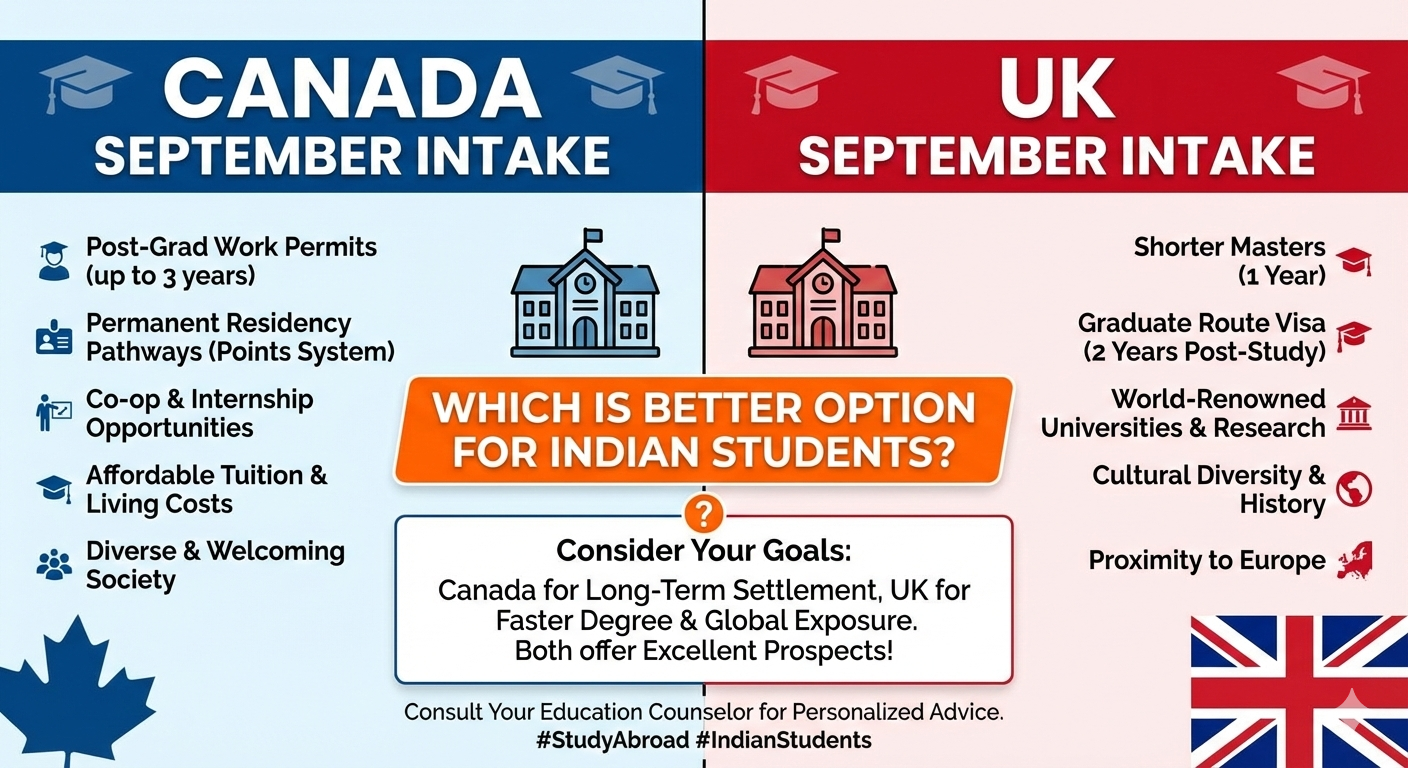

Indian students getting ready for higher studies abroad keep going back and forth between September intakes in Canada and the UK. Both are the big main starts with pretty much every course on offer, but they’re different when it comes to how long you study, what it costs, work right after, and the whole lifestyle thing. Canada draws a lot for that longer stay-back and easier PR route, while the UK clicks for quicker masters that don’t break the bank and a solid work visa. As education consultants sort applications for both places, we see it really depends on whether you want to wrap up fast or hang around longer building experience. Let me run through the main points based on how things stand for 2025-2026.
What Courses You Can Pick From
Both September intakes give you the full spread business, engineering, IT, health, data science, arts at top universities.
Canada’s fall term has a massive range across places like University of Toronto, UBC, McGill, McMaster.
UK September’s the same kind of breadth with Oxford, Cambridge, Imperial, UCL, Manchester.
Pretty even here both are strong on popular fields for Indian students.
How Long It Takes to Finish
UK masters are almost always one year full-time packed and intense, but you’re done quick.
Canada masters usually run 1-2 years, often two if there’s co-op or research built in.
Indian students who want the degree fast and start earning sooner tend to go to the UK; those who like deeper projects or paid internships learn Canada.
What It Actually Costs
UK international masters tuition sits £15,000 to £35,000, with just one year, the total spend stays lower.
Canada CAD 20,000-50,000 a year, and with two years common, it adds up more even if per-year looks similar sometimes.
Living costs roughly the same (£/CAD 12,000-18,000 a year), but the UK’s shorter time abroad cuts the overall bill. Plenty of Indian families find the UK easier on the pocket long-term.
Work Rights After You Graduate
Canada’s PGWP gives up to three years for masters, great for building experience and the PR route through Express Entry.
UK’s Graduate Route is two years (talk of dropping to 18 months floating, but current two), no sponsor needed at first, any job counts.
Canada wins if longer stay and PR is the goal; UK for that guaranteed window without lottery worries.
How Tough Getting In Is and Deadlines
Both September intakes are competitive.
Canada fall deadlines run December previous year to March study permit caps bring extra uncertainty lately.
UK UCAS for undergrad has January equal consideration, postgrad deadlines vary but often earlier.
Both need solid profiles. Canada’s caps mean some get redirected; UK many rolling admissions.
Lifestyle and Settling In
Canada has huge Indian communities Toronto, Vancouver full of familiar food, events, temples.
UK similar in London, Manchester easy to find Indian groceries, festivals.
Canada winters can be harsh; UK milder overall.
Both welcoming, part-time work 20 hours a week allowed.
So, Canada or UK September, What’s Better?
No outright winner. Canada fits if you want longer time abroad, co-op experience, PR ambitions. Start early either way. Apply for canada September intake before 2026 deadline, usually December 2025 to March 2026.
Choose UK September intake before 2026 deadline, UCAS January 2026 for undergrad equal, postgrad varies.
Always check the latest on official sites, caps, and visa change. Pick what matches how long you see yourself staying and your career plans.