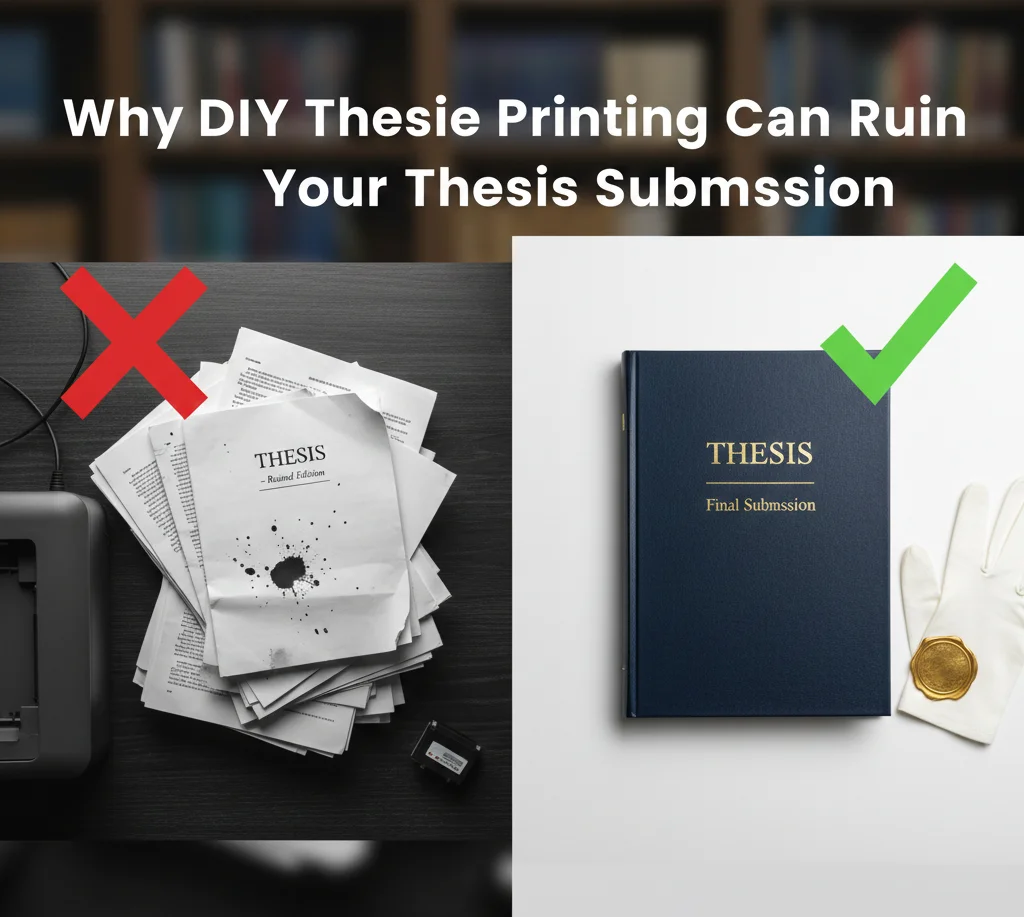

DIY thesis printing can be stressful and risky if not done carefully. If you have ever tried to print your thesis yourself or through a local printer, you probably know the stress. And this is not just a random opinion that going DIY is bad for your paper’s approval. It is a rather tested claim. One tiny margin slip or a missing page number can take to back to square one. The point where you started. Many students underestimate DIY thesis printing and the risks it carries.
Also, according to the survey results, universities take formatting very seriously. In fact, improper margins are among the top 5 reasons theses get desk‑rejected before examiners even read them. Sadly, this is not the only hidden cost of choosing local print shops. This blog talks about a few more. Let’s discuss each in detail.
DIY Thesis Printing That May Risk Your Thesis Approval
There are countless surveys about why 90% of the total theses are declined. Some are formatting-based, while the others are content-related. Though no matter what these reasons are, rejection is a huge problem for a scholar.
It means reprinting, rebinding, and sometimes missing graduation deadlines. So, avoid DIY printing or relying on local shops just because it is cheaper. It is time that you realize, they are only low-priced at first. With time, many hidden costs appear for the students, and that usually ends up in a brutal rejection.
Important Note
‘Small mistakes quickly snowball into big setbacks, and going DIY or local is one of those.’
All in all, there is no joking when you are speaking of an aspect this sensitive. You either give it your best or stay prepared to receive a bad comment on your months of hard work. Remember, the best thesis journal publication services are always a tap away.
9 of the Most Overlooked Printing Flaws
- Uneven margins are big trouble. They don’t match university rules and can lead to rejection.
- Missing or misaligned numbers can confuse examiners and break the flow of reading.
- Universities often require specific fonts. Using the wrong fonts is a signal of negligence.
- Crowded or uneven spacing makes text hard to read and looks unprofessional.
- Using thin or cheap paper, which tears easily, reflects poorly on the paper’s presentation.
- Weak ink can bitterly affect the thesis’s quality, reducing both readability and credibility.
- Charts that spill over margins look bizarrely chaotic for a professional document.
- Loose or incorrect binding can cause pages to fall out, risking rejection.
- Graphs printed in poor colour quality lose clarity. This could harm the comprehensibility.
With all these overlooked printing flaws, it is safe to say that depending on do-it-yourself printing or a local printer shop is not the right approach. Instead, the students should find a reliable thesis writing service that won’t just guide them through the writing process, but also ensure flawless printing.
Let’s Discuss Why Strict Margins Are Required
Margins may feel like a small detail to scholars, but universities treat them as a sign of professionalism and consistency. Strict margin rules are a visible support for examiners, making them comfortably read and grade your research work. Hence, a paper with sloppy margins suggests carelessness, even if the content is strong. The supervisors are bound to emphasize formatting as much as arguments, after all, presentation impacts credibility.
DIY Approach Eats Your Time Like a Hungry Monster
No exaggerating it at all. The DIY printing just feels cheaper and faster initially. A few weeks in, and then it shows you how it backfires. A student might have to spend hours adjusting margins, fixing page numbers, and troubleshooting printer jams.
So yes, what looks like savings can quickly become a hungry monster devouring your precious time, energy, and confidence. Or worse, you might start finding small mistakes after submission. The next day, you find yourself dealing with a reprint and rebind. All this chaos can double the costs and ruin your first impression.
Hence, it is better to hire the top-notch print and binding services Toronto. There won’t be any hidden truths then. These professional services may cost more upfront, but they protect against wasted hours and last-minute panic.
Cost Variances Between Professional & DIY Thesis Printing Canada
| Factor | Home Printer | Local Print Shop | Professional Specialist |
| Upfront Cost | Low. C$50-C$100 (for ink/paper only) |
Moderate. C$100-C$200 (for printing & binding) |
Higher. C$150-C$350+ (for printing & binding) |
| Binding Type | Spiral/Coil (Almost always rejected) |
Thermal/Coil (Likely not preferred) |
Hardback Casebound (Universities prefer it) |
| Hidden Cost Risk | – Time lost
– Chances of page numbering errors. – Forcing a complete, expensive re-do. |
– Format rejection.
– Misses the fixed 1.25-inch or 1.5-inch binding margin required by Canadian universities. |
– Zero to Low.
– Files are often reviewed for technical compliance before printing. |
FAQs
- How do local printing shops differ from specialized academic printers?
The local shops are found to be more focused on everyday printing and thus might miss strict academic rules. The specialized printers, however, know university standards, check margins, and ensure formatting meets requirements.
- Why do supervisors emphasize formatting as much as content?
Your supervisor wants your thesis to look professional and meet official guidelines. The biggest reason behind this is that proper formatting shows attention to detail and respect for academic standards. So, at times, even strong content can be rejected for not following the set rules.
- How can I check if my margins meet university standards?
It should be your standard practice to always read your university’s thesis guidelines carefully. Then you can change the word processor settings to adjust margins exactly as required. Lastly, print a test copy or ask your supervisor to confirm before final submission.
- What role does binding style play in thesis acceptance?
The way you bind your work says a lot about you. Especially the durability and presentation. Using the wrong style can lead to rejection, while correct binding will make sure your document looks professional.
Is DIY Thesis Printing Reliable for Final Submission?
Printing your thesis might feel like the final step, but it’s often where students make the most mistakes. They forget that universities don’t just grade content. They enforce strict formatting rules, and margin errors are among the top five reasons for desk rejection.
However, this self-called-for rejection does not come alone. It costs the scholars their precious time, money, and sometimes their graduation. This is your sign to be extra careful about how to get your thesis printed before the final submission. Remember, if you pick the wrong path, there will be a lot of doubled expenses.